
 LabelLogic Live
 Planglow Account Login


What food businesses need to know (and how to get compliant in time)
Jun 3, 2026
The New York Allergen Bill, signed into law late 2025, requires food businesses statewide to display allergen information on all prepackaged food prepared and sold on the same premises.
The deadline for compliance is November 2026 - and for busy food businesses that means it’s time to get ready.
Here's everything you need to know about the legislation and how to get compliant with confidence.
What's the New York Allergen Bill S5381?
This new bill amends New York's Public Health Law and Agriculture and Markets Law to close a long-standing gap in allergen labeling requirements. Previously, only prepackaged food made off-premises was required to carry allergen information. Food prepared and packaged onsite - at a deli counter, in a cafe kitchen, at a food truck - could be sold without any allergen labeling at all.
Under the new allergen legislation for New York, any food establishment - defined as any place where food is prepared and intended for consumption, including retail stores - must label prepackaged food with clear allergen information before it is sold.
Importantly, the law applies to food that is "prepared, prepackaged and offered or sold to customers on the same premises." It does not apply to food that is sold unpackaged, or food that is packaged only after a customer has placed an order (like a custom sandwich wrapped at the counter).
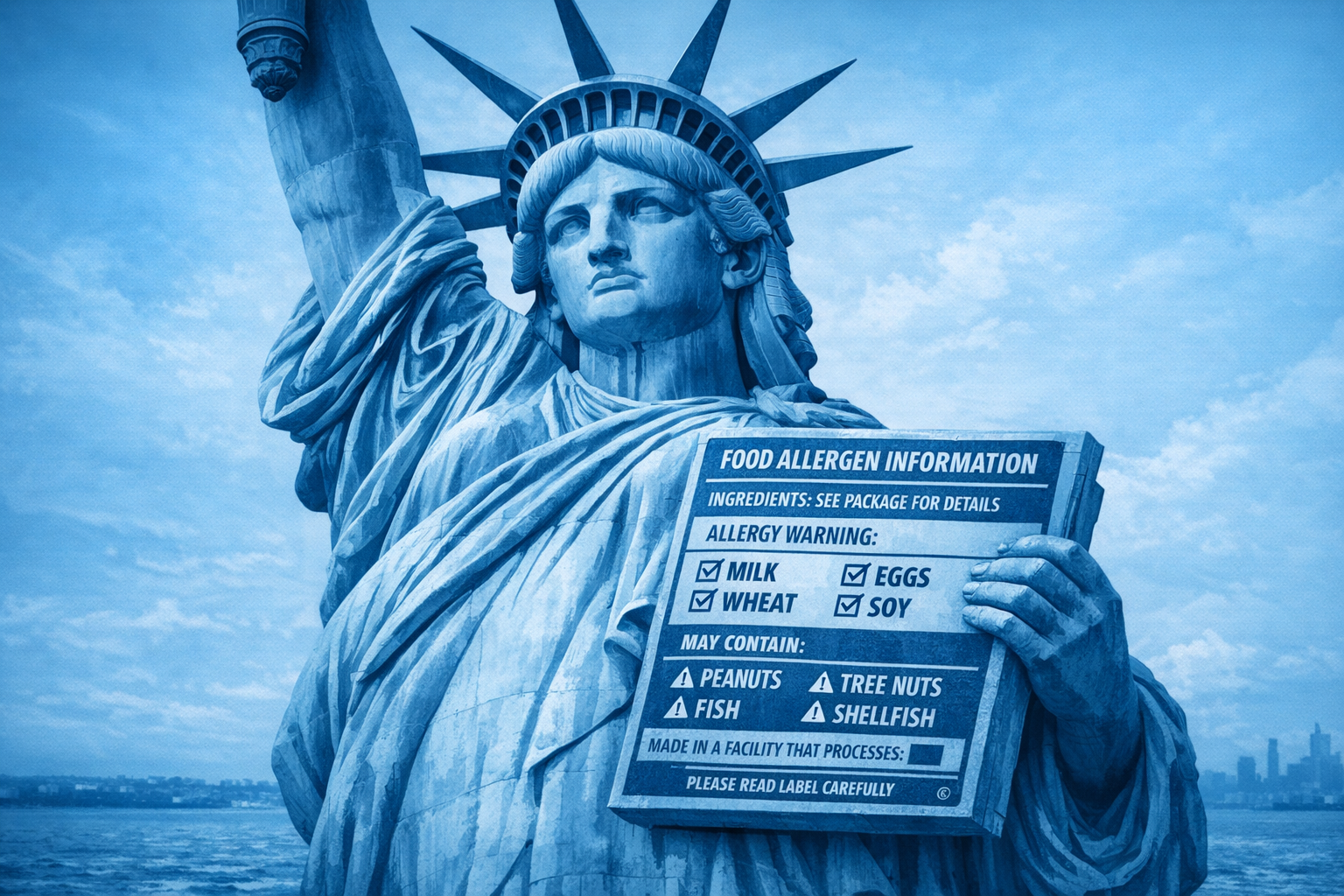
The 9 major allergens you must declare
The New York Allergen Legislation requires food businesses to declare the following 9 major food allergens:
- Milk
- Eggs
- Fish
- Crustacean shellfish
- Tree nuts
- Wheat
- Peanuts
- Sesame
- Soybeans
This includes any food that contains protein derived from these ingredients. It does not include highly refined oils derived from these ingredients, or any ingredient already exempt under the federal Food Allergen Labeling and Consumer Protection Act of 2004 (FALCPA).
Labeling must be presented in the form and manner required by FALCPA. This means businesses need to align their on-premises prepackaged food labels with established federal allergen labeling standards.
Allergen labeling - safety first
Out of a population of around 20 million people, New York is home to approximately 2 million living with food allergies. For those allergy sufferers, the ability to quickly and confidently check a label before eating can be the difference between a safe meal and a life-threatening reaction.
This New York Allergen Bill was introduced in large part thanks to Jared Saiontz. Born with 26 allergies, he reached out to his state senator, flagging that the prepackaged foods he was buying from gas stations, delis and supermarkets routinely lacked the allergen information he needed to make a safe choice.
The bill is a direct response to that gap and a recognition that food prepared and sold on the same premises deserves the same level of transparency as anything manufactured offsite.
Talking about the Bill with Allergic Living, New York Assembly member, Jen Lunsford said:
“It is not an exaggeration to say this Bill will save lives. With the addition of a small sticker, we are ensuring that those who need this life-saving information will be able to make faster, more informed decisions about the food they purchase.”
Who needs to act?
If you operate any of the following in New York and sell prepackaged food made onsite, the Allergen Bill S5381 applies to you, including:
- Delis and sandwich shops
- Bakeries
- Cafes and coffee shops
- Food trucks
- Restaurants with a grab-and-go offer
- Retailers that prepare and package food onsite
The November 2026 deadline means that businesses need to act now. Getting your labeling process right takes planning, especially if you're managing rotating menus, multiple recipes or locations.
How LabelLogic makes allergen compliance simple
Managing allergen information accurately and staying compliant with changing legislation - cost-effectively, efficiently and easily - is exactly what LabelLogic Live was built to solve.
LabelLogic is an award-winning, cloud-based food labeling app, which works on any internet-connected device - tablet, phone, laptop, or desktop - and prints to standard printers.
Here's how it supports businesses preparing for the New York Allergen Bill:
- Automatic allergen highlighting. LabelLogic automatically identifies and highlights allergens within your product recipes, so you're not manually checking every ingredient every time. Any change to a recipe triggers an automatic review - removing the risk of human error.
- Built for all business sizes. Whether you're a single-site deli or a multi-location food operation, LabelLogic scales with you. Your head office can manage a centralized recipe database while individual sites print their own labels - with full control over permissions.
- Always compliant: When legislation is updated, the software updates with it. Your business can stay compliant not only with the New York Allergen Law, but with future food labeling legislation too. It’s the ultimate peace of mind.
- Always up to date: the built-in recipe builder pulls data from 8,000+ foods in the USDA database allowing LabelLogic to calculate and lawfully state what’s in your products - including the presence of allergens.
- No expertise required. You don't need a graphic designer to produce compliant, professional-looking labels. The app is designed to be intuitive for anyone, even those new to food labeling requirements.
- Free support, always included. Every LabelLogic subscription includes access to Planglow's technical support team - by phone, live chat, or remote access - at no extra cost.
One of our customers, Paula from Petroc College told us:
“We had a lot of software companies contacting us, but LabelLogic was so user friendly and low cost, it fitted our requirements, meaning we didn’t need to look elsewhere. It’s really easy to use. For example, if I was building a sandwich product (in the software) - I select the code for the bread, the code for the butter, and the code for the filling - it’s as easy as that - and I know it’ll be correct. It gives me peace of mind and that’s what this is really about”.
Don't wait until November 2026
The November 2026 deadline for the New York allergen Bill is fast approaching. The food businesses that will find the transition easiest are the ones that start building compliant labeling processes now.
Getting your recipe data into a system, testing your label designs, and training your team all takes time. Starting early means compliance becomes part of your workflow, not a last-minute panic.
Take a free trial of LabelLogic
Take a demo of LabelLogic to see how it can work for your business with a free software trial before committing. If you'd like a walkthrough tailored to your business, we can also offer free one-to-one labeling consultations.